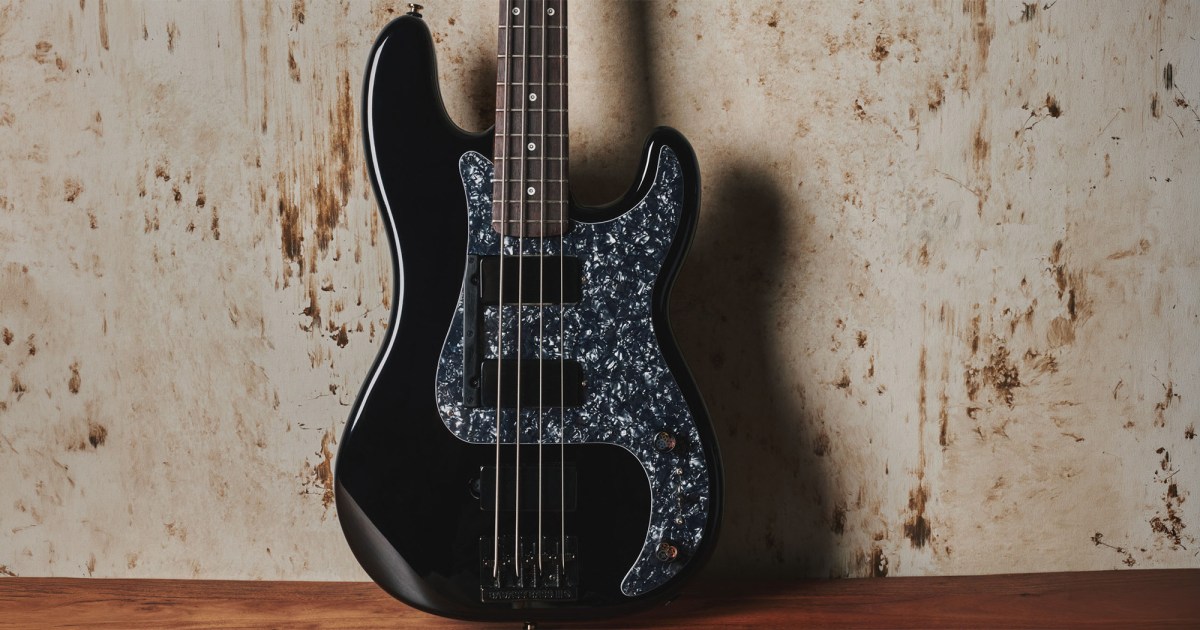
As a Grammy Award-winning mix engineer, bassist Doc Wiley knows about getting a good sound. He’s also a practical, working musician. Today, we’re diving into the story of his Doc Shop Strat-o-Bass, a Frankensteined four-string that began as a Fender Standard Precision Bass and was transformed by luthier Bill Foley of German Village Music Haus in Columbus, Ohio.
“I’ve been playing with The Waiting, celebrating the music of Tom Petty and the Heartbreakers, since 2013,” Wiley explains. “On any given night, my incredibly talented bandmates may have 12 to 18 guitars onstage, not counting the basses. Because faithfully performing the Heartbreakers’ catalog already requires guitar changes on nearly every song, I wanted to avoid adding another instrument to the changeover chaos. The Strat-o-Bass is my solution: one bass to rule them all.”
Starting with the Precision as a foundation gives a good starting point for the feel and playability. From there, Wiley consulted with pickup icon Larry DiMarzio about how to get the most tone out of it. They settled on three DiMarzio Relentless Neck DP295 pickups controlled with a five-way switch and a custom G&L-inspired tone circuit.
“And because Bill is one of those wonderful instrument wizards who hears a half-formed idea and somehow turns it into something useful,” Wiley explains on his Substack, “he also added a very cool wiring trick: with a pull of the tone knob, the middle pickup gets into a voicing inspired by that Rickenbacker 4001 middle-pickup flavor.”
The hardware was upgraded to Leo Quan tuners and a Badass III hi-mass bridge. The back of the bass has another intriguing feature: a resonant chamber.
“The three rounded, concentric chambers are proportioned around the relationship between the fundamental, major third, and fifth of a musical note—an intonated resonant system designed to encourage consonant resonance throughout the instrument,” Wiley writes. He adds that the resonator seems to make the bass ring forever, “like it has unfinished business and a hotel room somewhere in 1978.”
All of these features add up to an instrument that fits the gig and doesn’t feel too precious to use. Wiley documented his thought process and the creation on his Substack (Check out part one and part two), where he wrapped up with a final thought.
“At the end of all this, the point is not to own a custom bass. The point is to own a bass that helps you make music,” he said. “The right upgrades can make a mid-priced bass feel like home.”
Doc Shop Strat-o-Bass Photos:


